
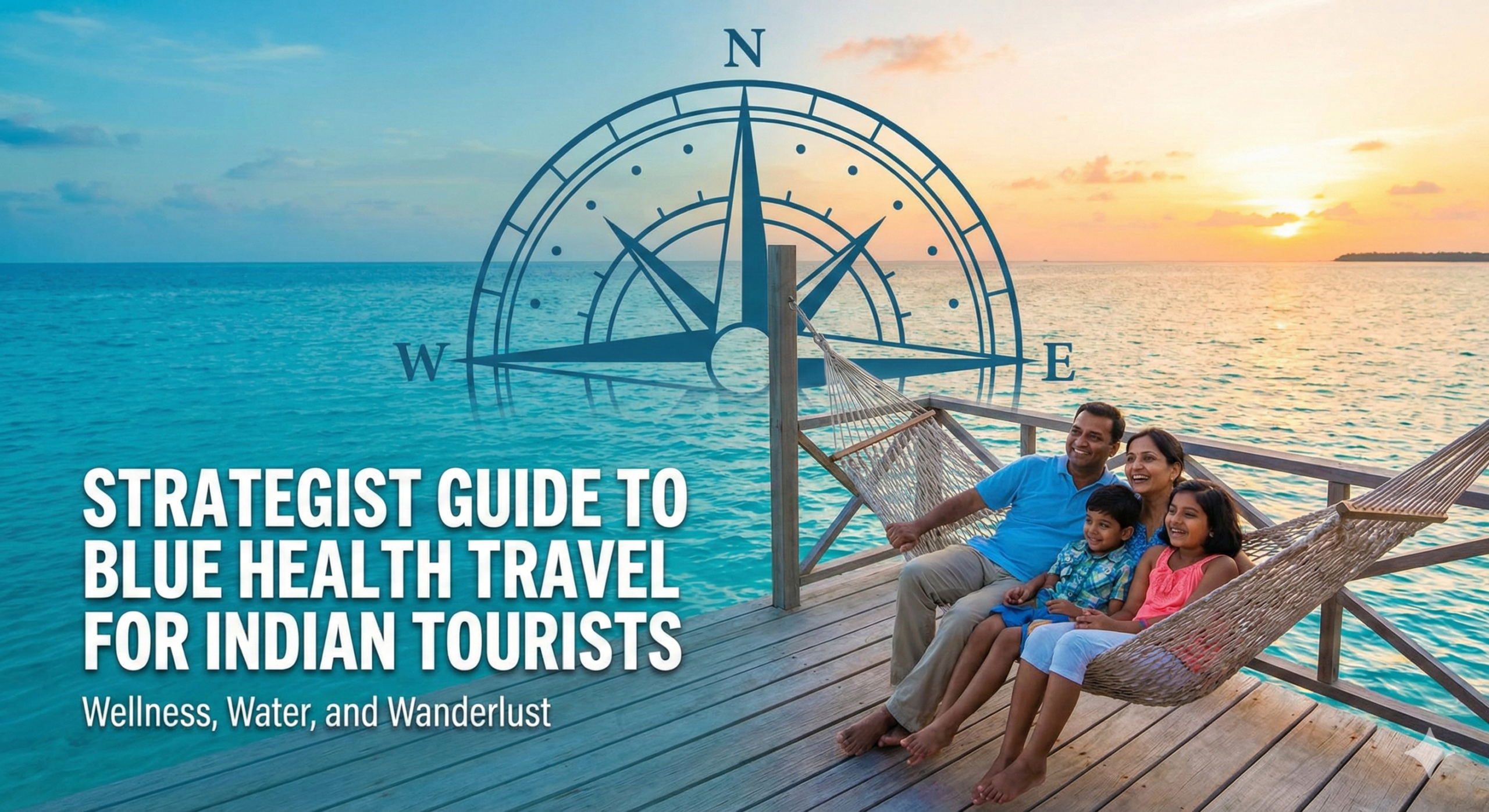
Beyond the Beach: A Strategist’s Guide to Blue Health Travel for Indian Travelers
Estimated reading time: 8–10 minutes
✨ Quick Takeaways
- Blue Health Science: Immersion in water environments is proven to lower cortisol and reset mental clarity.
- Tiered Destinations: From budget-friendly Vietnam to luxury Swiss glacial lakes, there is a water retreat for every budget.
- Visa & Logistics: Practical advice on navigating Schengen appointments and E-visa nuances for Indian passport holders.
- Dietary Ease: How to maintain Jain, Vegetarian, or Vegan diets while exploring international waters.
In This Guide
For years, the Indian travel market focused on “checking off” monuments. You went to Paris for the Eiffel Tower, London for Big Ben, and Switzerland for a quick photo on a mountain peak. But recently, a shift has occurred in my office. Clients no longer come to me asking for a 10-city marathon. They come to me because they are exhausted. They are tired of the noise in Bangalore, the humidity in Mumbai, and the relentless pace of Delhi.
They are looking for what researchers call “Blue Health.”
Blue Health is the scientific evidence that being near, in, or under water significantly lowers cortisol levels and improves mental clarity. For the Indian traveler, this isn’t just a trend; it is a necessity. However, planning a water-based wellness trip requires more than just booking a hotel with a sea view. It involves navigating visa hurdles, ensuring dietary requirements are met, and choosing the right body of water for your specific temperament.
The Reality of Blue Health: It’s Not Just a Beach Vacation
Most people equate water travel with sitting on a beach chair in Goa. That is not Blue Health. Blue Health is about immersion. It could be the sound of a glacial stream in the Alps, the stillness of a lake in Vietnam, or the rhythmic pulse of the Indian Ocean.
Where to Go: Three Tiers of Water Wellness
Depending on your budget and the strength of your patience for visa paperwork, here are the three best ways to experience Blue Health today.
1. The Low-Friction Entry: Vietnam (Halong Bay and Ninh Binh)
Vietnam has become the go-to for Indians because the E-visa process is straightforward (usually 3–5 working days) and the value for money is exceptional. While most tourists crowd the streets of Hanoi, the real “blue” healing happens in the water-filled landscapes of Ninh Binh or the quieter corners of Lan Ha Bay.
- The Vibe: Limestone karsts rising out of emerald green water. It is silent, ancient, and deeply calming.
- For the Indian Palate: Vietnam is surprisingly friendly for vegetarians. Most “Phở” spots in tourist areas now offer a “chay” (vegetarian) version, and Indian restaurants are plentiful in Danang and Hanoi.
2. The Mid-Tier Classic: The Maldives
Do not dismiss the Maldives as “just for honeymooners.” We are seeing a massive spike in multi-generational Indian families booking private residences.
- The Vibe: Total isolation. You are surrounded by 360 degrees of turquoise.
- Visa: Visa on arrival for Indian passport holders, which removes the stress of embassy visits.
- Connectivity: Direct flights from Mumbai, Delhi, and Kochi make this a 3-to-5-hour journey.
3. The Aspirational Gold Standard: The Swiss Lakes (Interlaken and Lucerne)
If you have the budget and a valid Schengen visa (or the 30-day window to get one), the Swiss lakes offer a different kind of Blue Health. This isn’t salt water; it’s crisp, cold, mineral-rich glacial water.
- The Vibe: Deep blue lakes surrounded by snow-capped peaks. The air itself feels different.
- The Experience: Instead of the crowded Jungfraujoch, I advise my clients to take a private boat on Lake Brienz. The water is a unique turquoise color due to glacial particles, and the silence is absolute.
Best Time to Visit: Timing Your Escape
Timing is everything. If you go at the wrong time, your “peaceful” water retreat becomes a battle against monsoons or suffocating humidity.
- Vietnam: Go between February and April. Avoid the humidity of June and July, which can make being outdoors unbearable.
- Maldives: November to April is the dry season. If you travel in June, you will get lower rates, but you risk being confined to your room by heavy rain.
- Switzerland: June to September. This is when the lakes are accessible for swimming and boat tours. Avoid November; it’s gray, damp, and many mountain services are closed for maintenance.
Realistic Budgeting (Estimated in INR)
When planning, don’t just look at the flight cost. For a true Blue Health experience, you need to stay on or near the water.
| Destination | Tier | Estimated Cost (Per Couple, 6 Nights) | What it Includes |
|---|---|---|---|
| Vietnam | Budget/Boutique | ₹1,50,000 – ₹2,00,000 | 4-star hotels, internal flights, E-visa, private cruises. |
| Maldives | Mid-Range Luxury | ₹3,50,000 – ₹5,00,000 | All-inclusive resort, sea-plane transfers. |
| Switzerland | Luxury | ₹6,00,000 – ₹8,50,000 | 5-star lakeside hotels, Swiss Travel Pass (1st Class), fine dining. |
The Indian Traveler’s Logistics Checklist
Visa Realities
The Indian passport is gaining strength, but logistics remain a hurdle.
- Schengen (Switzerland): Start your process at least 3 months in advance. VFS slots are notoriously difficult to get in cities like Mumbai and Delhi.
- Vietnam: Ensure your E-visa name matches your passport exactly. A middle name discrepancy can lead to a boarding denial.
Suggested 7-Day “Blue Health” Itinerary: The Lake & Sea Hybrid
- Day 1-2: Arrival and Acclimatization. Choose a property with a direct view of the water. Do not book any tours. Simply sit by the water.
- Day 3: Gentle Movement. A private boat tour or a guided kayak session. The goal is to be on the water.
- Day 4: Deep Immersion. This is the day for snorkeling, swimming, or “hydrotherapy” at a spa.
- Day 5: The “Hidden Gem” Experience. Visit a local fishing village or a secluded waterfall.
- Day 6: Reflection. A day of complete digital detox. No phones. Just the water.
- Day 7: Re-entry. Slow travel back to the hub city for your flight.
Actionable Tips: Do’s and Don’ts
Do:
- Invest in a Private Transfer: After an 8-hour flight, a private boat transfer is the difference between starting your trip stressed or relaxed.
- Carry Universal Adapters: Switzerland uses Type J. Most Southeast Asian countries use A, C, or G.
- Book “Water-Adjacent” Spas: Ensure the spa has a visual connection to the water to double the relaxation benefit.
Don’t:
- Don’t Over-schedule: Avoid the “five cities in ten days” trap. Stay in one or two places maximum.
- Don’t Ignore the “Off-Season” Dangers: In Southeast Asia, “off-season” can mean jellyfish season. Always ask about water safety.
- Don’t Forget Sun Protection: Water reflection strengthens UV rays. Use high-SPF, reef-safe sunscreen.
Tailored Advice for Different Travelers
For Solo Travelers: Look for “Blue Health” retreats that offer communal dining but private rooms. Vietnam’s wellness retreats in Da Nang are perfect for safety and community.
For Families: Choose a destination with a “Kids’ Club” that focuses on marine education. This allows parents to enjoy the silence while children learn about coral reefs. The Maldives excels at this.
For Honeymooners: Avoid villas near the main jetty to escape boat engine noise. Look for villas on the “sunset side” for ultimate quiet.
How Let’z Go Travel Simplifies Your Journey
Planning a trip centered around wellness and water sounds simple, but the logistics are anything but. We handle the friction—from securing hard-to-get Schengen appointments to ensuring a remote resort understands Jain meal nuances. We don’t just book hotels; we vet the “vibe.”
Frequently Asked Questions
Is “Blue Health” travel expensive?
Not necessarily. While Switzerland is high-end, destinations like Rishikesh in India or the coastal towns of Vietnam offer incredible water-based healing at a fraction of the cost.
I can’t swim. Can I still benefit from Blue Health?
Absolutely. The psychological benefits come primarily from the sight and sound of water. Being on a boat or sitting on a balcony overlooking a lake provides the same neurological “reset” as swimming.
What should I pack for a water-focused trip?
Beyond swimwear, pack a pair of high-quality noise-canceling headphones for the flight and a waterproof dry-bag for your phone and documents.
Conclusion
The era of the “exhausting vacation” is ending. As we deal with more digital noise and urban congestion, the pull toward the water will only grow stronger. Whether it’s the salt air of the Maldives or the glacial stillness of a Swiss lake, “Blue Health” is the ultimate luxury in a world that refuses to be quiet.
Let us help you find your water. You’ve earned the silence.